ODFL — The LTL carrier that earns like software

ODFL — The LTL carrier that earns like software

Old Dominion Freight Line (NASDAQ: ODFL) passes all three hard screening criteria: ROE of 31.34% / 27.90% / 23.93% for FY2023–FY2025 (well above the 15% threshold each year), positive and growing free cash flow ($811.8M → $1.018B TTM), and a trailing P/E of 51.30× that sits below the LTL peer median of ~60× despite being above ODFL's own 5-year average of 32.39×. The article covers the full bull/bear framework — including the June 10 Amazon LTL entry that triggered a 5% single-session selloff, the Citi Sell downgrade, the May operating update showing +12.3% daily revenue acceleration, and the incremental margin leverage that makes ODFL a leveraged play on the freight cycle recovery.

US Stock Pick: 3-Year ROE > 15%
June 15, 2026 · 9:34 PM
1 subscriptions · 30 items
Screening result: all 3 hard criteria pass. Trailing 3-year ROE above 15% — confirmed, at 31.34% / 27.90% / 23.93% for FY2023–FY2025 (average-equity method, cross-verified via StockAnalysis and SEC EDGAR XBRL). Positive free cash flow — confirmed, every year on record, growing from $811.8M in FY2023 to $1.018B TTM. Reasonable valuation — conditional pass: trailing P/E of 51.30× sits 58% above the 5-year average of 32.39×, but below the LTL peer median of ~60×, and the forward P/E of 38.80–43.11× (Finviz and StockAnalysis respectively, reflecting different consensus EPS estimates for FY2026) represents a meaningful discount to the trailing figure as earnings are expected to recover.
The investment tension here is specific. Old Dominion Freight Line (NASDAQ: ODFL) operates trucks — decidedly unsexy capital equipment — yet it earns operating margins north of 24%, generates over $1B in free cash flow on $5.5B in revenue, carries virtually no debt ($40M), and has held a net cash position for years while every major competitor is leveraged. The stock has returned +51.6% over the past 52 weeks. On June 10, Amazon announced it was entering nationwide less-than-truckload shipping, and ODFL dropped 5% in a single session. Citigroup downgraded to Sell on June 12. The consensus holds at 24 analysts split mostly at Hold with an average price target below the current share price.
ODFL closed June 12, 2026 at $245.75, with a 52-week range of $126.01–$252.03. Market cap: $51.1B. 1

What Old Dominion actually does

Old Dominion Freight Line is one of the largest less-than-truckload (LTL) motor carriers in North America. The company was founded in 1934 by Earl Congdon Sr. and Lillian Congdon and is headquartered in Thomasville, North Carolina. 2
LTL is a specific segment of freight transportation that sits between parcel delivery (think FedEx/UPS shipping individual boxes) and full-truckload (FTL, where one customer fills an entire trailer). In LTL, a shipment typically weighs between 150 and 15,000 pounds — a pallet or several pallets — too large for parcel networks but too small to justify a dedicated truck. Old Dominion and its peers consolidate freight from multiple customers into shared trailers, routing it through a hub-and-spoke network of service centers to individual delivery points. Pricing is based on weight, freight classification, distance, and fuel surcharges. 2
The network ODFL operates today spans 261 service centers across 48 continental US states, with approximately 55,000 tractors and trailers and an average full-time workforce of 20,264. 3 The company is non-union — what management calls the "OD Family Culture" — while a competitor like ABF Freight (owned by ArcBest) operates under Teamsters contracts. That structural difference matters for cost flexibility, scheduling, and margin.
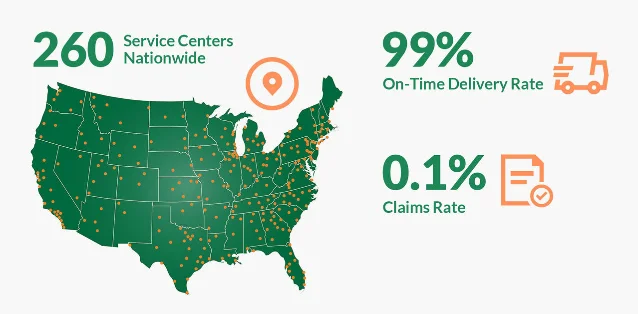
Two service quality metrics define how Old Dominion sells itself to shippers: 99% on-time delivery rate and a cargo claims ratio below 0.1%. Those numbers have earned the company the #1 ranking in the Mastio National LTL Carrier Quality Survey for 16 consecutive years. 3 CEO Marty Freeman, who joined ODFL in 1989 and has been in the role since July 2023, stated in the Q1 2026 earnings call: "Our industry-leading service metrics for the first quarter once again included 99% on-time service and a claims ratio below 0.1%. These service standards form the foundation of our unmatched value proposition." 3
Old Dominion service centers, on-time delivery rate, and claims rate — infographic
260 service centers nationwide, 99% on-time delivery rate, 0.1% claims rate. 4

Screening criteria: the three gates

Loading stats card…

Gate 1 — ROE track record

The channel screens for ROE above 15% in each of the past three fiscal years. ODFL clears the gate in every year, though the trend is declining — from a peak of 31.34% in FY2023 down to 23.93% in FY2025 as the freight recession compressed revenue and net income.
Fiscal yearNet incomeAvg. stockholders' equityROEGate
FY2023 (Dec 31, 2023)$1,240M$3,957M (derived)31.34%
FY2024 (Dec 31, 2024)$1,186M$4,251M (derived)27.90%
FY2025 (Dec 31, 2025)$1,024M$4,280M (derived)23.93%
TTM (through Q1 2026)$1,007M$4,353M (derived)23.13%
Data from StockAnalysis, cross-referenced against SEC EDGAR XBRL (CIK 0000878927). 1 5 The equity figures above are derived from net income ÷ ROE as reported by StockAnalysis; exact period-end equity values require direct 10-K extraction.
The ROE decline requires context. All three years clear the 15% gate by a substantial margin. The compression reflects a genuine freight cycle downturn: ODFL's revenue declined in each of FY2023, FY2024, and FY2025 after peaking at $6.26B in FY2022, and net income fell from $1.377B (FY2022) to $1.024B (FY2025). This is not a structural deterioration in the business model — the company's operating margin of 24.57% (TTM) remains more than double the next-best LTL peer. It is cyclical earnings compression acting on a denominator (equity) that declined slowly due to continued buybacks.
CFO Adam Satterfield noted on a prior earnings call that in previous LTL recovery cycles (2014–15, 2017–18, 2021–22), ODFL outgrew peers by 900 to 1,000 basis points in volume. 6 If the freight market continues recovering into 2026–2027 and ODFL's volumes reaccelerate toward its network's 55,000-shipment/day capacity (currently running at ~41,000/day), ROE should expand again.

Gate 2 — Free cash flow

FCF = operating cash flow minus capital expenditures. ODFL has delivered positive FCF in every year tracked, and the trajectory is consistently upward despite the revenue downturn.
Loading chart…
PeriodOperating cash flowCapExFCFYoY
FY2023~$1,248M~$436M$811.8M−11.4%
FY2024~$1,310M~$422M$888.0M+9.4%
FY2025~$1,370M~$415M$955.1M+7.6%
TTM (Mar 2026)$1,408M$389M$1,018M+6.6%
FCF data from StockAnalysis, cross-verified with Finviz (both report P/FCF = 50.21, implying TTM FCF of ~$1,017M at the current market cap). 1 7
FCF margin has expanded steadily: 13.84% in FY2023 → 17.38% in FY2025 → 18.65% TTM. The mechanics here are notable: while revenue has been declining, ODFL has been managing CapEx downward at the same time. CapEx guidance for FY2026 is $265M, down 36% from the $415M invested in FY2025. 3 Management deployed heavy network investment during the downturn — $575M CapEx in FY2025 across real estate and equipment — and is now pulling back as the network has 35%+ excess capacity. The FCF generation at full-utilization volumes is the bull case's central number: consensus estimates put FY2026 FCF at approximately $1.28B. 6
At a $51.1B market cap, the TTM FCF yield is 1.99% — not compelling in absolute terms, but meaningful for a business with this capital efficiency profile and room to grow into its installed network. 1

Gate 3 — Valuation

Two tests: against ODFL's own 5-year history, and against LTL sector peers.
vs. 5-year history
MetricFY2021FY2022FY2023FY2024FY20255Y avgCurrent
Trailing P/E39.37×22.85×35.46×31.87×32.38×32.39×51.30×
Historical P/E data from Macrotrends. 8 The current trailing P/E of 51.30× is 58% above the 5-year average of 32.39× — that's the number that appears in every bear argument. However, the trailing P/E at a cyclical trough is a misleading signal: ODFL's trailing earnings of $4.78/share (diluted TTM) are depressed by three years of freight recession. The forward P/E ranges from 38.80× (Finviz) to 43.11× (StockAnalysis), depending on the EPS consensus estimate used — both are substantially closer to the 5-year average than the trailing figure. The 5-year P/E low was 22.85× in FY2022, the same year the stock hit its multi-year trough before recovering. 1 8
vs. LTL and trucking peers (data as of June 12, 2026)
TickerCompanyTrailing P/EForward P/EEV/EBITDAP/BROED/EOp. margin
ODFLOld Dominion51.30×39–43×29.77×11.63×23.93%0.0124.57%
SAIASaia50.72×39.25×22.22×4.89×10.23%0.1010.34%
XPOXPO Inc.78.43×44.96×23.68×14.48×19.94%2.219.23%
JBHTJ.B. Hunt44.82×37.37×17.94×7.59×16.68%0.447.36%
ARCBArcBest70.21×26.83×16.54×3.00×4.33%0.362.00%
Peer median~60×
Peer data from StockAnalysis. 1 9 10 11 12
ODFL's trailing P/E of 51.30× ranks third lowest in the five-company peer set — below the peer median of ~60× (excluding Knight-Swift, which has a trailing P/E of 389× due to near-breakeven earnings in FY2025). ODFL is the only company in this group with a net cash position ($248M vs. net debt at all five peers), a D/E ratio of 0.01, an operating margin above 20%, and an ROE above 20%. 1 That quality premium does exist — ODFL's EV/EBITDA of 29.77× is the highest in the group, reflecting the market's willingness to pay up for its margin and balance sheet profile.
The valuation gate passes as a conditional "reasonable": the stock is not cheap on a trailing basis, but it is below its LTL peer group and converging on historical norms on a forward basis as earnings recover.

Revenue and earnings

Loading chart…
PeriodRevenueYoYNet incomeOp. marginNet margin
FY2021$5,256M$1,034M26.47%19.68%
FY2022$6,260M+19.1%$1,377M29.40%22.00%
FY2023$5,866M−6.3%$1,240M27.97%21.13%
FY2024$5,815M−0.9%$1,186M26.55%20.40%
FY2025$5,496M−5.5%$1,024M24.76%18.63%
TTM (Q1 2026)$5,456M−4.8%$1,007M24.57%18.46%
Data from StockAnalysis, confirmed against ODFL earnings releases. 13 14
Revenue peaked at $6.26B in FY2022 and has declined for three consecutive years. The driver is the freight recession: industrial production softened, freight volumes across the LTL industry contracted, and even ODFL — which managed to hold or gain market share — was not immune to volume pressure. Diluted EPS fell from $6.09 in FY2022 to $4.84 in FY2025. 13
The margins still tell the real structural story. ODFL's 24.57% operating margin (TTM) compares with Saia at 10.34% and XPO at 9.23%. No other carrier in the public LTL space runs margins in ODFL's range. The compression from the FY2022 peak of 29.40% to the current 24.57% reflects the operating leverage that runs both ways: when volume is below the break-even point for the network, incremental freight flows through at high incremental margins — but volume declines hurt proportionally. The recovery thesis depends on volumes recovering through that same inflection point upward.
Q1 2026 (reported April 29) showed the trajectory improving. Revenue was $1,334.7M (down 2.9% year-over-year), operating ratio (OR) was 76.2%, and diluted EPS was $1.14 — beating the Street's consensus of $1.05 by 8.6%. 3 LTL tons per day were still down 7.7% year-over-year, but LTL revenue per hundredweight (a standard LTL pricing measure: revenue per 100 pounds of freight) excluding fuel surcharges rose 4.4% — evidence that pricing discipline is intact even in a soft volume environment.
The most recent operating update (June 3, 2026) reported May daily revenue up 12.3% year-over-year. 15 That is a material acceleration from Q1's 2.9% decline. Weight per shipment rose 1.6% year-over-year — a leading indicator of industrial demand. Management guided for 300–350 basis points of OR improvement from Q1's 76.2% to somewhere around 72.7–73.2% for Q2.
Analyst consensus for FY2026 is $5.77B in revenue (+5.0% year-over-year) and EPS of $5.43 (+12.2%). FY2027 consensus: $6.23B and EPS of $6.32. 16

Balance sheet health

Old Dominion's balance sheet is unusual for a capital-intensive trucking company.
MetricTTM / latestContext
Cash & equivalents$288.1M
Total debt$40.0MLikely equipment financing
Net cash position$248.1MAll 5 peers carry net debt
Debt-to-equity0.01Virtually debt-free
Interest coverage2,260×Minimal interest expense
Current ratio1.57
Quick ratio1.44
Altman Z-Score18.92>3.0 is generally considered safe
Piotroski F-Score6/9Moderate financial strength
Data from StockAnalysis and Finviz. 1 7
ODFL is not publicly rated by S&P Global Ratings or Moody's — a confirmed fact, not an omission. With only $40M in total debt, the company has no practical reason to carry a public credit rating. 17 For comparison, XPO carries S&P BB / Moody's Ba2 (below investment grade) on $3.9B in net debt; FedEx Freight received S&P BBB− upon its June 2026 spinoff. 17
Capital return to shareholders runs alongside the fortress balance sheet. ODFL has raised its dividend for nine consecutive years; the current quarterly payout is $0.29/share ($1.16 annualized, 0.47% yield) with a 23.80% payout ratio. 3 The company repurchased $88.1M of stock in Q1 2026 alone, producing a ~2.14% buyback yield. Combined shareholder yield is approximately 2.6%. 1

Competitive positioning

Old Dominion's moat is structural, not narrative. The mechanics are straightforward: more service centers in more dense geographic locations means shorter pickup-and-delivery routes per shipment, lower cost per hundredweight, and faster transit times. Each terminal that gets added to a network becomes more valuable to the existing 260, not less. Running 261 service centers across 48 states produces a density advantage that a startup carrier cannot replicate without years of CapEx and market development. 18
Four specific structural advantages reinforce this:
  • Non-union labor. ODFL's workforce operates outside Teamsters contracts. ABF Freight (ArcBest's LTL division) is unionized. Yellow Corporation — which went bankrupt in August 2023 — was heavily unionized and removed roughly 8–10% of US LTL capacity from the market. Non-union status gives ODFL flexibility on scheduling, work rules, and benefit structures that union shops cannot match.
  • 16 consecutive #1 quality rankings. The Mastio National LTL Carrier Quality Survey ranking is a purchasing signal for enterprise freight managers. A 99% on-time rate and sub-0.1% claims ratio effectively mean shippers don't need to budget for loss-and-damage claims, which lowers the total cost of using ODFL even at rate premiums over lower-service competitors. 3
  • 35%+ excess capacity. ODFL can handle approximately 55,000 shipments per day; it is currently running at ~41,000. That idle capacity is not wasted money — it was intentionally built. During the down cycle, ODFL invested $575M in CapEx in FY2025. When volumes recover, incremental freight flows through the existing fixed-cost network at very high incremental margins (mid-40% range, per prior management guidance). The excess capacity position makes the company a leveraged play on an LTL volume recovery. 6 18
  • Pricing discipline. ODFL has achieved positive LTL revenue per hundredweight (ex-fuel) growth even during a freight recession. Q1 2026: +4.4% year-over-year; Q2 QTD through May: +5.4%. 3 15 ArcBest's ABF Freight announced a 5.9% average rate increase effective June 22, 2026, which is consistent with an industry that continues to exercise pricing discipline despite soft volumes. 3
The service gap metric came from CFO Satterfield himself on an earnings call: "The service gap between us and our competition is as wide as it's ever been, if not getting wider." 6

Risk factors

Amazon's LTL expansion (the headline risk). On June 10, 2026, Amazon announced that its Amazon Supply Chain Services had expanded LTL freight to nationwide any-destination coverage, backed by 80,000+ trailers and 24,000 intermodal containers. ODFL's stock dropped 5.1% that day; Saia fell 3.3% and the freshly independent FedEx Freight fell 7%. 19
The risk is real but calibrated by two analysts whose assessments diverge. Morgan Stanley's Ravi Shanker wrote that Amazon "may be able to capture meaningful market share even if they are unable to offer best-in-class service levels immediately. This could strike at the perceived 'moat' of real estate footprint and service that form the central pillar of the LTL thesis today." 19 Bloomberg Intelligence's Lee Klaskow disagreed: "Shippers that would likely leverage Amazon would be cost-conscious, shipping low-value freight with little concern over service." 19 Raymond James characterized the announcement as "not near-term thesis-changing" for established LTL carriers. 6
The question is which customer segment ODFL loses, if any. Enterprise shippers paying a service premium for 99% on-time delivery are unlikely to risk supply chain reliability for a cost saving from a new entrant — particularly one without a proven LTL claims history or terminal density. The at-risk segment is probably cost-sensitive, low-value freight that ODFL's yield management already prices away from. That is a legitimate concern about the total addressable market ceiling, but not an imminent threat to ODFL's premium-service core.
FedEx Freight as a direct public comparator. FedEx Freight completed its spinoff from FedEx Corp on June 1, 2026 (ticker: FDXF), creating a well-capitalized, pure-play LTL competitor with its own stock price and analyst coverage. FDXF targets a 12% operating margin — versus ODFL's 24%+ — but operates at a larger scale and with brand recognition. The spinoff makes ODFL's premium valuation more visible to comparison; it may also intensify price competition if FDXF pursues volume share aggressively to improve its own OR. 19
Valuation premium leaves no margin for disappointment. ODFL trades at 51.30× trailing earnings and 39–43× forward consensus (depending on the EPS estimate source). The average analyst price target is $221.82, 9.7% below the current price. 16 Citi downgraded to Sell on June 12 with a $228 price target — the most recent analyst action. BMO Capital maintains Buy at a $260 target (the Street high, above current price). 16 With the stock near its 52-week high ($252.03) and RSI of 65.83 approaching overbought territory, any Q2 tonnage miss could translate quickly into multiple compression. 1
Cyclicality and macro sensitivity. LTL demand is tied to manufacturing output and industrial production. The ISM Manufacturing PMI (Institute for Supply Management's Purchasing Managers' Index) returned to expansion (52.6) in January 2026 after 12 months of contraction — a positive signal. But the recovery is fragile: tariff uncertainty under the current administration creates headwinds for goods movement, diesel price swings affect demand through ODFL's fuel surcharge pass-through mechanism, and the May operating update (showing volume still down 3.8% year-over-year) confirms the recovery is not yet at full momentum. 6
Insider selling. David Congdon (Executive Chairman) sold $10.1M of ODFL stock in February 2026; Earl Congdon (Chair Emeritus) sold $4.9M in the same month; director Greg Gantt sold $4.2M in May 2026. All transactions appear to be pre-arranged 10b5-1 sales. The Congdon family still holds approximately 11.69% of shares. 7 Structured sales by insiders near a 52-week high don't automatically signal trouble, but the direction is one-way. Short interest is 4.98% of shares outstanding (5.56% of float) with 4.99 days to cover — not a short squeeze setup, but also not negligible. 1

Near-term catalysts

Q2 2026 earnings — estimated July 29, 2026. This is the most important near-term data point. Management guided for 300–350 basis points of OR improvement versus Q1's 76.2%, which would put Q2 OR in the 72.7–73.2% range. The May daily revenue acceleration of +12.3% year-over-year is a strong leading indicator. If Q2 tonnage also turns positive year-over-year and OR lands within the guided range, the current forward P/E in the 39–43× range becomes harder to argue against. If tonnage disappoints, the premium multiple has nowhere to hide. 3 15
LTL freight cycle recovery. The Yellow Corp bankruptcy (August 2023) removed 8–10% of US LTL capacity. That structural tightening has not yet fully translated into demand-driven volume recovery because industrial activity remained soft through most of 2024–2025. As manufacturing PMI sustains above 50 and industrial production grows, that capacity removal will have more pricing power. ArcBest/ABF's 5.9% rate increase effective June 22 is one signal that carriers see pricing momentum ahead. 3
Incremental margin leverage. ODFL's network currently processes approximately 41,000 shipments per day against capacity for 55,000. Management has described incremental margins on volume above the network break-even point in the mid-40% range. Each 1,000-shipment-per-day increase in volume runs through the fixed-cost network at disproportionately high contribution margins, which is why revenue growth in a recovery outpaces operating expense growth. The FY2022 operating margin peak of 29.40% was achieved at roughly 47,000–50,000 shipments per day. Returning to that volume level implies significant OR improvement from the current 76.2%.
Dividend: nine consecutive years of growth. The quarterly dividend of $0.29/share was raised 3.6% in May 2026. 3 At a 23.80% payout ratio, there is room for continued increases even in a soft earnings year. The combined shareholder yield (dividend + buyback) of approximately 2.6% is not the headline reason to own ODFL, but it reflects a management team allocating capital conservatively and systematically rather than making dilutive acquisitions.

Bull / bear framework

Bull case

1. Significant operating leverage into a volume recovery. ODFL's network handles approximately 41,000 shipments per day against 55,000-shipment-per-day capacity. The fixed-cost base (261 service centers, equipment fleet, driver headcount) does not scale linearly with volume. When shipments-per-day recover toward 2022 levels, incremental revenue flows through at margins far above the company average. This is the same dynamic that produced the FY2022 peak operating margin of 29.40% — and at 24.57% today, there is roughly 500 basis points of operating margin available if volumes recover. May's +12.3% daily revenue growth suggests that recovery is in progress. 15
2. The balance sheet is genuinely unusual for a trucking company. $248M in net cash, D/E of 0.01, interest coverage of 2,260×. All five major publicly traded LTL/trucking peers carry net debt. ODFL has the financial flexibility to invest aggressively in the next freight upcycle, pursue opportunistic terminal acquisitions (as it did when Yellow went bankrupt), repurchase stock at scale, or simply hold cash as a margin-of-safety buffer. This capital structure is not an accident — it reflects decades of retained earnings that were not levered up for financial engineering. 1
3. The quality moat compounds in recovery cycles. CFO Satterfield's observation that ODFL has outgrown peers by 900–1,000 basis points in volume in previous recovery cycles is consistent with what the service quality advantage predicts: when freight managers have capacity and need reliable delivery, they return to the carrier with the best on-time rate and the lowest claims ratio. That pattern, if it repeats in 2026–2027, translates directly to market share gains and volume-driven margin expansion. 6
4. Amazon risk likely hits the wrong customer segment. Amazon's LTL service targets cost-conscious shippers with low-value freight. ODFL's customer base is primarily enterprise shippers who pay a premium specifically to avoid the delays, damage, and service variability that come from less-established carriers. If Amazon's early LTL operation resembles its typical logistics quality curve — functional, then iteratively improved — established shippers are unlikely to risk supply chain reliability for unproven savings. The impact, if any, most plausibly falls on freight at the low end of ODFL's addressable market. 19

Bear case

1. The trailing P/E of 51.30× has significant downside if the recovery disappoints. ODFL's 5-year average trailing P/E is 32.39×. The stock is priced for a recovery that produces materially better earnings than current TTM. If Q2 tonnage misses management's implied guidance, or if the macro freight recovery stalls — manufacturing PMI rolling back below 50, tariff-driven freight volume contraction — earnings could remain depressed and the multiple would need to contract toward historical norms. A reversion to the 5-year average multiple on current TTM EPS of $4.78 would imply a price of approximately $155 — the low end of the analyst target range (Rothschild Redburn's $155 target). 1 16
2. Analyst consensus implies downside from current levels. 24 analysts cover ODFL: 6 Strong Buy, 2 Buy, 13 Hold, 0 Sell, 3 Strong Sell. Average 12-month price target: $221.82 — 9.7% below June 12's closing price of $245.75. The median target is $225. Only BMO Capital's $260 target sits above current levels. 16 A stock trading above the average analyst target, with RSI near overbought territory and near its 52-week high, requires the earnings recovery to show up rapidly to justify the forward multiple.
3. Amazon is a structurally new threat, not a temporary sentiment shock. Amazon enters markets with patience. Its LTL service today may target low-value cost-conscious shippers, but its playbook historically involves underpricing, capturing data and route density, then expanding upstream. Within three to five years, Amazon's trailer fleet and intermodal containers could develop enough density in high-traffic corridors to offer viable alternatives to mid-tier shippers who currently default to ODFL not because of 99% on-time performance, but because it is the established national option. That multi-year scenario is speculative, but Morgan Stanley's Shanker framed it with specific language: this "could strike at the perceived 'moat' of real estate footprint and service." 19 It is a long-duration risk, not a quarter-end one.
4. Margin compression has been persistent for three years. Operating margin fell from 29.40% in FY2022 to 24.57% in the TTM period. Each year of the freight recession narrowed the gap between ODFL's cost structure and its revenue base. The company has managed the decline better than peers — but the question is whether the FY2022 peak margin is achievable again, or whether ODFL is structurally entering a lower-margin phase as competitors (FedEx Freight, Amazon) invest in their own networks and reduce the pricing power of ODFL's service premium. The freight cycle recoveries of 2014–15 and 2017–18 did not face a well-funded Amazon LTL entrant. 18

Operating data snapshot

MetricValueSource / date
Price$245.75June 12, 2026 close
Market cap$51.1B
52-week range$126.01 – $252.03
YTD performance+56.73%Finviz
Trailing P/E51.30×StockAnalysis, June 12
Forward P/E38.80× (Finviz) / 43.11× (StockAnalysis)Two sources report different consensus EPS
EV/EBITDA29.77×StockAnalysis
P/B11.63×StockAnalysis
P/FCF50.21×StockAnalysis / Finviz
PEG2.74StockAnalysis
FCF yield (TTM)1.99%$1,018M / $51,110M
Dividend yield0.47%$1.16/share annual
Dividend growth streak9 years
Beta1.18StockAnalysis
Short interest4.98% of shares outstandingStockAnalysis
Analyst consensusHold (24 analysts)Avg. target $221.82
Next earnings (est.)July 29, 2026
Credit ratingNot publicly ratedMinimal debt ($40M)
Sources: StockAnalysis.com, Finviz, Macrotrends, SEC EDGAR XBRL, ODFL earnings releases (Business Wire). 1 7

This article is for informational purposes only and does not constitute investment advice. All financial data sourced from StockAnalysis.com, Finviz, Macrotrends, SEC EDGAR XBRL, ODFL Q1 2026 and Q2 2026 operating update earnings releases (Business Wire), TIKR, FreightWaves/Yahoo Finance, Bloomberg/Yahoo Finance, and GetTransport.com. Prices as of June 12, 2026 close. Investors should conduct their own due diligence before making any investment decisions.
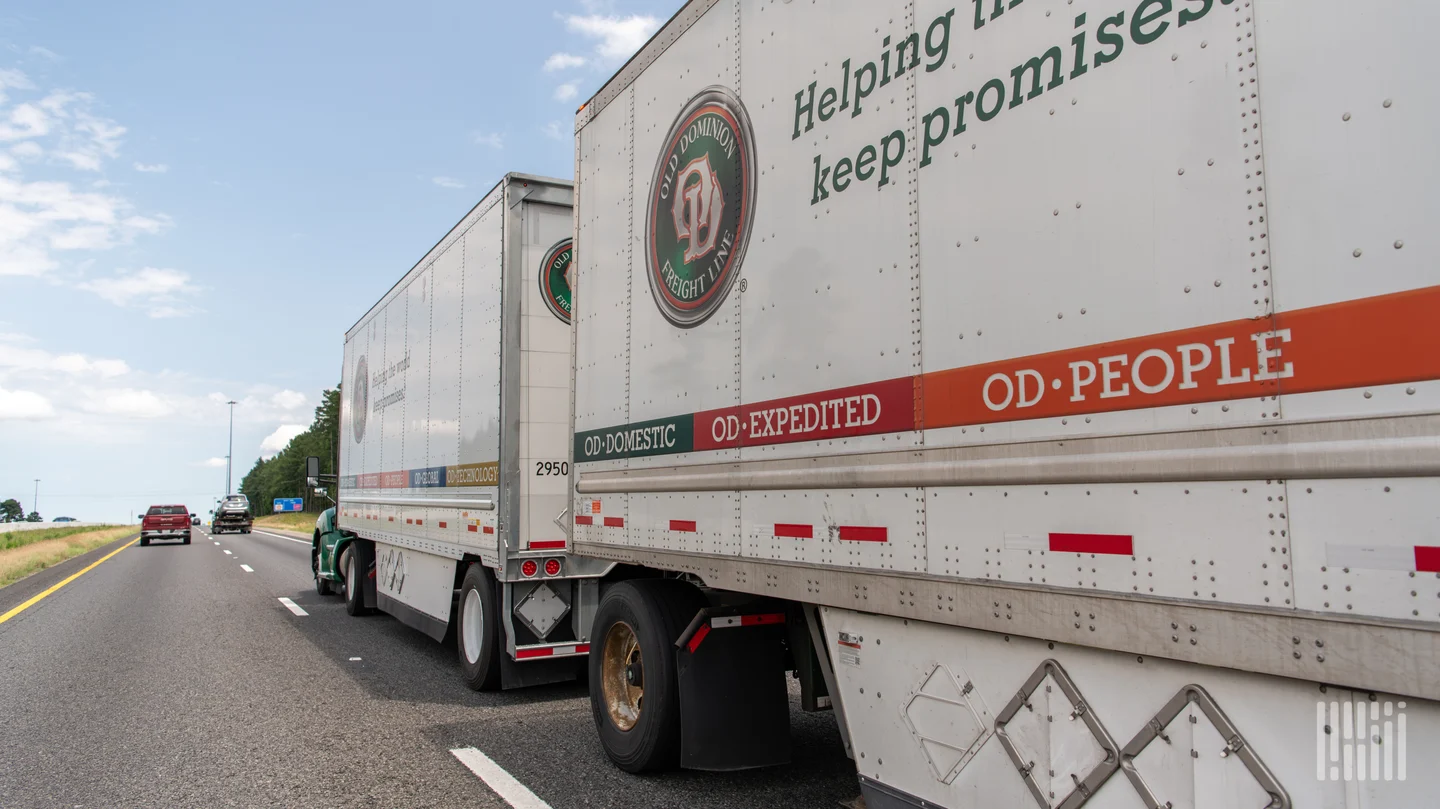
Cover image: Old Dominion Freight Line pup trailers on a US highway. 18

Add more perspectives or context around this Post.

  • Sign in to comment.